Posts tonen met het label Review. Alle posts tonen

vrijdag 8 augustus 2014

Review: Veronica Roth, Divergent (Divergent, #1) + Movie

I said it before and I'll say it again, it's a miracle if I read a book close to its release, especially if it's a new series. One such miracle was Divergent by Veronica Roth. Not long after the paperback release, I bought my copy of this supposedly fenomenal new YA dystopian novel and it only took another month or three for me to get around to reading it. I was on a roll back then! With the movie release, I revisited my thoughts on the book and sat myself down for the movie.

In the field of YA, the main players have become the dystopian novels (*). One of those is Divergent by Veronica Roth. This book has gained a massive following and has got almost nothing but glorious reviews, some even saying that it is better than The Hunger Games. Since I absolutely loved this series - The Hunger Games, that is - I decided to pick up Divergent to see if it is really that good. Comparing books to The Hunger Games, however, is a tricky business, cause the expectations are really high and this makes that disappointment is never really far away. I will, however, try to keep Katniss at bay and not compare all too much.


In Beatrice Prior's dystopian Chicago, society is divided into five factions, each dedicated to the cultivation of a particular virtue—Candor (the honest), Abnegation (the selfless), Dauntless (the brave), Amity (the peaceful), and Erudite (the intelligent). On an appointed day of every year, all sixteen-year-olds must select the faction to which they will devote the rest of their lives. 

For Beatrice, the decision is between staying with her family and being who she really is—she can't have both. So she makes a choice that surprises everyone, including herself.
During the highly competitive initiation that follows, Beatrice renames herself Tris and struggles to determine who her friends really are—and where, exactly, a romance with a sometimes fascinating, sometimes infuriating boy fits into the life she's chosen. 
But Tris also has a secret, one she's kept hidden from everyone because she's been warned it can mean death. And as she discovers a growing conflict that threatens to unravel her seemingly perfect society, she also learns that her secret might help her save those she loves . . . 
or it might destroy her.

As with every dystopian novel, the world as we know it is no more. In this case, today’s Chicago is destroyed and instead the city is divided into five Factions, each concentrating on a specific personality trait. The story revolves around Beatrice ‘Tris’ Prior and when she takes her test, the results are inconclusive. She is Divergent. She is dangerous. What follows is a whole book filled with training montages, since every initiate into a new faction has to be trained in order to become a member. Tris chooses Dauntless, the brave, as her new faction and thus is her training really exciting. She learns to fight, shoot and overcome her fears. But there are things going on in the city. Things that will strike close to home for Tris.
I really liked what happed in this book, plot wise. The book starts off with the aptitude tests and I was immediately engrossed in the story. It is never boring and things are happening so fast that you just want to keep on reading. I had a hard time putting the book down and as I result, I breezed through it in no time. The world Roth has created is very fascinating and makes you want to read on in order to learn something new again and again (**). I liked how the Factions were based on personality and how people were actually conditioned to act and think in a certain way. The underlying message, being that we can’t rely on one single trait, was not really being shoved down the reader’s throat, but it would have been quite the task to actually miss the point Roth was trying to make (***)

I did have some issues with the plot, however, which refrained me from giving it the highest score possible. First of all there is the worldbuilding. Like I said, this world – or dystopian society – is really fascinating and very imaginative, but it is never really explained. How did this society come to be? How does it work? There is some information on it, sure, but I felt it was not enough. I guess we will learn more about it in the books to come, but I would have liked a little history on this. Is only Chicago like this? Etc. Also, the factions rely heavily on their members, still, it’s almost easier to become factionless than become a member (****). That struck me as a bit odd as well. However, whilst I did wonder about these things while reading, it’s not a major issue, just a random thought, if you will. Something that did bug me a bit about the plot, was the ending. I though the actual war and fighting was all handled in such a way that things were a bit too convenient, with her mother popping up at the right time and stuff like that. Veronica Roth is still a young writer and this is her very first novel, so I won’t hold it against her, but I thought it a bit of a shame that she isn’t that good at concealing secrets or twists. There are two big twists here, one concerning a character and one about the plot, but both were heavily hinted at and while I couldn’t guess the exact nature of the latter twist, the overall idea was pretty clear to me way before Tris figured it all out. There were just - too? - many hints along the way and they were pretty obvious. But like I said, even though that could have been handled different, I won’t hold it against her.

Next to a fascinating plot, there are a lot of characters here and these were handled fairly well. It’s not easy to have a bunch of characters and give them each their own voice, but Roth managed to do this. The guys were a bit of an all-one-and-the-same and who-are-you-again? bunch, but the ones that mattered managed to stand out. I also liked the mixed bag of characters you’re getting here. Some are really relatable, where others are just despicable in every single way. A big pro here is how the characters aren’t all that black and white, but rather a muddled shade of grey. As a main character, Tris is likeable in the same way Katniss was. Both are very strong young women who aren’t all that likeable at the beginning but you grow to like them over time. Tris does a better job at making you like her than Katniss does, however. She’s a bit less hard-edged. Her love-interest, Four, is a very nice character as well and I like how their relationship grows and isn’t the main focus of the book. It’s also nice to see that Veronica Roth isn’t afraid to kill her characters.
A small issue here as well, though. This book wasn’t very surprising in terms of characters. When Tris meets Eric and the woman from Erudite, she mentions how she dislikes them and doesn’t trust them. These two turn out to be the main instigators of the war, so yes, no big surprises there. It’s not that I really minded that, but a little twist to who the villains were would have been nice. Where the characters weren't goodie two shoes nor absolutely evil, even in their greyness you could easily tell which one belonged to which side.
As for the writing style, it is excellent. It’s quite a big book, nearing 500 pages, but the pages turn like there’s no tomorrow. It helps that the font size is quite big, but still the writing is really fluent and gripping in the right places.
People like to compare things and when talking about a specific niche like YA dystopian novels, comparisons rear their head pretty quickly. I even did it by comparing Tris to Katniss, just to make a point, but other than that I try to abstain from comparing books that are unrelated. Instead, it try to enjoy what I read for what it is and judge it on its own merits and not on those of another book. Still, when you hear comparisons stating that Divergent is better than The Hunger Games, you can’t really help but secretly making one for yourself. I did, and I liked The Hunger Games better. So there you have it. I do believe that this comparison is completely useless, though, cause both aren’t really that comparable, I think. What I do know is that Divergent is an enjoyable read. I did have some issues with it, but that didn’t detract from the fact that I liked reading this and seeing that this is Roth’s debut and how it turned out, I am willing to give her a lot of credit, cause she did a very good job.


Discover which Faction you belong to. Or are you Divergent as well?


(*) More recently, YA contemporary is becoming the thing to read - much thanks to The Fault In Our Stars, I presume - and the odd Fantasy tries to wriggle its way into the spotlight, but another literary tsunami as we have seen with the dystopian wave hasn't occured to my knowing.  
(**) That being said, I would NOT want to live in this world, though. The amount of times they use needles and inject different kinds of serums into their bodies is just insane. Hopefully they have some very effective cure for HEP/HIV...
(***) But then again, Subtlety isn't one of the five Factions, so clearly all is forgiven!
(****) Some ideas for recruiting posters: "We want you! ... After which we'll do our utmost best to not want you at all!" or "Please feel welcome and make yourself at home... while you still can!"


Upon the release of Divergent in the movie theaters, I had already read the complete trilogy and with it lost quite a lot of my interest in it (*). I did, however, watch the movie when I had the chance, cause I really liked the book and I was hoping for an exciting movie such as The Hunger Games and Catching Fire. Alas, I ended up feeling quite disappointed.

I found the movie to be a good portrayel of the book as a whole, but I found the overal ambience of the novel, however, to be missing. There was something exciting about the book, about the training and how Tris was doing in Dauntless. For me, the movie lacked that feeling of excitement and times, it was just plain boring. The climax also didn't cut it for me, to be honest. A good example of how the overall ambience of the movie was less than the book, is the ferris wheel. I thought this was a very powerful scene in the book and here, it was just some climbing. The zipline-scene, however, was as great as I imagined it to be.
As for the ending, I'm not sure what to think of it. I mean, why go through all that trouble to inject Jeanine with the mind-control serum just to order her to shut the system down. Couldn't they just have ordered the Dauntless to stop attacking? I don't know, but that struck me as a bit odd. Another odd thing, was the focus they put on the 'Faction before blood' thing and saying goodbye to your family. However, the different Factions are shown working together... It's difficult to rhyme those two.
As for the characters, I found the portrayel of Tris and Four to be good. Perhaps Tris was not exactly as I had imagined, but I was certainly not disappointed by Shailene Woodley's performance. Their relationship was a bit cheesy, with lots of moments for the audience to drool over Four, but overall I enjoyed them.
The other characters, however, felt a bit like cardboard to me. There just wasn't enough time to get to know the other characters, which diminished the impact of what happened to Al and Will a lot. Also, the motivations behind Eric and Peter's actions were not clear and they came across as douchebags. As for the latter, his personality was toned down a whole lot. By deleting a certain scene with a knife, he's just a bully instead of the Peter we know from the book.

The scenery was quite close to perfection. I can't clearly remember how I envisioned this Chicago, but I was very much in awe of the Chicago we saw in the movie. The music was great as well - I mean, how can Ellie Goulding be anything but great? - but I did find it to be distracting at times. The songs were great, but it might have been better to use an instrumental score instead of the lyrical. But this is just a minor issue.

All in all, while the movie had its great moments, I just wasn't all that impressed with it and the book certainly is way better. I'm not sure about the movie adaptations of the next two books, since I found Divergent to be the best book in the trilogy, but I guess I'll see them anyway.

(*) Thank you for that, Insurgent and Allegiant.
 

woensdag 6 augustus 2014

Review: Daniel Abraham, The King's Blood (The Dagger And The Coin, #2)

The first book in a big series is always tricky business. You have to balance a whole lot of worldbuilding with setting up the plot and introducing characters, but at the same time, you have to make sure that your book is exciting enough to draw readers in and that it can, more or less, stand on its own. The Dragon's Path, the first book in Daniel Abraham's The Dagger And The Coin series didn't completely succeed in that feat. The second book, however, made good on the promise that The Dragon's Path implied.

After having read the first book in The Dagger And The Coin series by Daniel Abraham, I was left with mixed feelings. My expectations were far higher than the book could live up to, since every other review I read made a favourable comparison to George R.R. Martin. It was, however, no Song Of Ice And Fire, and thus it took me a little while to pick up the second book in the series. When I did come to it, the book proved why this series got so much critical acclaim to start with. The Dagger And The Coin might not be as ambitious as A Song Of Ice And Fire, but it can definitely hold its own against those big epic series and The King's Blood does everything to prove that.

 
War casts its shadow over the lands that the dragons once ruled. Only the courage of a young woman with the mind of a gambler and loyalty to no one stands between hope and universal darkness.

The high and powerful will fall, the despised and broken shall rise up, and everything will be remade. And quietly, almost beneath the notice of anyone, an old, broken-hearted warrior and an apostate priest will begin a terrible journey with an impossible goal: destroy a Goddess before she eats the world.

Whereas the plot in the first book was all over the place and didn’t seem to have any real direction (*), The King’s Blood did have a good sense of direction and purpose. Everything that went down in The Dragon’s Path is coming round with repercussions attached. His surprising save of the young monarch has put Geder in the position of Regent, albeit with the use of some magics. Another one who finds herself in a position she didn’t bargain for is Cithrin, in charge of her own branch of the Medean Bank but under severe supervision. All the while, Dawson and Clara try to survive in a politically precarious environment. In the end, they’ll be faced with the decision of staying true to the throne or to themselves and it’s a choice that might cost them dearly.
Upon finishing The Dragon’s Path, I felt like I read a very long and elaborate prologue and this feeling got reaffirmed with The King’s Blood. Whereas the first book has put the pieces in place, the game of chess has now officially begun. Most of the characters have gotten engaging plotlines with lots of intrigue and deception – I’m especially looking at Cithrin here, the intrigue and plotting is really becoming a second nature for her. While I liked most of the plotlines, I wasn’t that convinced by Marcus’s. It’s not that it was lacklustre, but I definitely missed something there to make me fully connect to his story. In this bunch of five POV’s he falls right in the middle and gets lost there. His story is nor really intriguing nor is his character development taking a turn for the better nor despicable, which makes him the grey mouse in a bunch of brightly coloured personas. Talking about characters that go down the wrong path, Geder is the prime example here. Whereas he garnered some sympathy previously, he’s becoming more and more off-putting as the series – and this book – goes along. This is certainly not a bad thing in terms of my interest for his storyline and the novel in general, on the contrary. The thing that makes his story engaging and off-putting at the same time, is that you witness his progression from hero to tyrant with decisions that fall ever so lightly on the wrong side of the moral spectrum. In this, he is strongly aided by the Priests of the Spider Goddess. With them, magic in slowly creeping in the story and it’s making it even more engaging. This proves once again that you don't need balls of fire weezing around or other mindblowing magical pyrotechniques to write a great Fantasy series. Just some subtle magical aid is all one needs.
While the different storylines are all of a nature that they keep you reading, I do miss the grander scale of some other big Fantasy series. Every character has his or her own little – or not so little – struggles, but it’s hard to find some overarching plot. The bigger picture, if you will, is missing. With three more books to go, I have no doubt that events will come together and tie everything up in one big epic knot.
The character development is pretty much on par with the respective storylines. It’s the ones I’ve mentioned before that truly come to their own in this book, wile Marcus is left standing on the side line. Perhaps it’s because characters like Cithrin, Clara and Geder are so engrossing, that a more even tempered character like Marcus does not stand out as much (**). Dawson portrays some of the same symptoms, but because of his political involvement, his storyline prevents him from befalling the same fate as Marcus. Master Kit, at last, has been a side character for long, but now he’s coming more and more to the front stage and he proves to be an intriguing character. I’m curious to see where the story takes him.
This has all come to be thanks to the solid writing from Daniel Abraham. While it is true that The King’s Blood, as was the case in The Dragon’s Path, starts off really slow, I can’t really critique Abraham’s writing. It’s all just very solid, with enough worldbuilding and exposition to set the stage and a change in pacing to get you hooked for the showdown.

The King’s Blood shows that, while you may not judge a book by its cover, you also can’t judge a series by its first book. The Dagger and The Coin series received lots of praise when the first book was just released and was compared to George R.R. Martin’s A Song Of Ice And Fire series. After The Dragon’s Path, however, this comparison felt like a marketing stunt to me, cause everybody was loving Game of Thrones at the time. The King’s Blood proved me wrong in proving the critiques wrong, cause by now I can see where people might get the comparison from. While I do miss the grand scale and some major epicness, The Dagger and The Coin is building up to become another great series that can hold its own in a landscape where Martin and the likes are busy conquering seven kingdoms and more.


Don't miss out on a great series and get your copy of this book right now!

(*) Despite the book being titled The Dragon's Path.
(**) He reminds me a bit of Eddard Stark, in that respect. While a great character, both don't really have that little extra to compete with more colourful characters, at least to me. That being said, you can't rely on the bold and beautiful all the time, so a Marcus is needed to even out the book.

dinsdag 5 augustus 2014

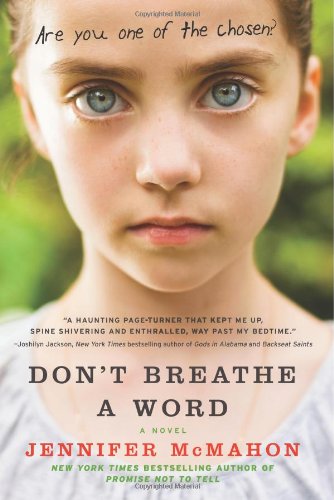
Review: Jennifer McMahon, Don't Breathe A Word


When browsing your local bookstore, GoodReads or whatever means you use to find a new book to read, some books are sure to pop up everywhere. It's very much possible to pave the street with Hunger Games lookalikes, and I lost count of how many times I came across a reference to The Fault In Our Stars this week. While I'm not trying to discourage anyone from reading those books - cause god knows I enjoy them very much myself - there are other books out there as well, and with a sole focus on what's hip and cool right now it's easy to miss out on the rest. A while back I came across a book that I had never heard of before, but one look at it made me want to read it.
 
I like pretty and/or fascinating covers, but I don’t let them cloud my judgement of the book. That is, I don’t judge a book solely by its cover. I’ve seen lots of books with very pretty or interesting covers, but when I dig a little deeper, the book turns out to be one of those I wouldn’t like in a million years, so no, I don’t buy based on face value alone. When I saw this book on my boyfriend’s shelves, however, I was immediately drawn to it. Those eyes, that creepy child, it just captivated me. Seeing as it was about Fairies and stuff, I decided to give it a try cause I needed to know exactly what that cover was hiding within those pages.


On a soft summer night in Vermont, twelve-year-old Lisa went into the woods behind her house and never came out again. Before she disappeared, she told her little brother, Sam, about a door that led to a magical place where she would meet the King of the Fairies and become his queen.

Fifteen years later, Phoebe is in love with Sam, a practical, sensible man who doesn't fear the dark and doesn't have bad dreams—who, in fact, helps Phoebe ignore her own. But suddenly the couple is faced with a series of eerie, unexplained occurrences that challenge Sam's hardheaded, realistic view of the world. As they question their reality, a terrible promise Sam made years ago is revealed—a promise that could destroy them all.
 
 
Let’s elaborate on the Fairy stuff. Fifteen years prior to the story, twelve-year-old Lisa went missing, kidnapped by the Fairy King to be his queen. Her brother Sam is left and turns his back to everything supernatural. When, in the present, he and his girlfriend Phoebe witness strange things, it seems Lisa is coming back and Sam’s beliefs are to be tested.
Seeing as I can summarise it in about three lines, the idea is pretty simple. The execution, however, is complicated and very well done. For those who can guess how this is all going to turn out, you should become a detective or something like that (*), cause whilst on the surface very simple, what lies underneath is everything but a simple plotline. There never was a point in the story where I felt like I knew what was going on. I always had some ideas, sure, but I never had the feeling like I knew it for sure this time around. The solution to the whole disappearance was quite shocking, I think, and the actual ending was just plain weird. In hindsight, I think it should have ended with the solving of the mystery and leave the epilogue for what it was. The whole book is very well constructed as a creepy, eerie, suspenseful mystery with a supernatural flavour to it. The solution to the mystery, how disturbing it may be, does fit and just adds to the atmosphere of it all. The ending – as in the epilogue – gave me just a big "what the hell????" feeling. Perhaps it’s because it comes so unexpected (**), but to me it felt a bit forced in order to provide some sort of solid reasoning behind everyone’s actions. Perhaps some readers might have appreciated it, but for me an explanation along the lines of ‘they’re all a bunch of loons’ would have been sufficient.
I thought the writing style was very fitting for this kind of story. The pacing was good and McMahon really know how to evoke a certain atmosphere. Especially the scenes who took place in the woods were written in a chilling fashion and gave me a claustrophobic feeling, even though it was out in the open. Another plus was how this book was constructed, with chapters alternating between Phoebe’s POV today, and twelve-years-old Lisa’s. Additionaly, I thought the illustrations and general lay-out of the book fitted the story very well and made the reading experience just a little nicer.
My only real complaint lies with the characters. What I love about reading, is how I get to know the characters and start to care for them. Here, however, that didn’t happen. I don’t feel like I truly know who Sam, Phoebe and Lisa are, and I sure don’t care about them. It’s not that they are not interesting, cause they are, as are the other characters in this book, but they didn’t engage me enough. For the most part of the book, they felt kind of one-dimensional. At times, they sort of seemed like cardboard figures who were making their way through the setting, instead of fleshed out characters interacting with what happened around them. They do have their own distinctive voices and you can tell them apart, but with so much happening in this book, they change very little and at times, they can’t get their emotions to come across towards the reader, I think. For me, that made the difference between liking and really liking this book.

After having read Don’t Breathe A Word, I can conclude that this book does give you what the cover evokes. It is a captivating, strange and by times disturbing story with a great opening line (***). Even though the characters aren’t what I would want them to be, I still enjoyed this book and if I should come across another of Jennifer McMahon’s books, I’ll sure be tempted to read it.


Fancy a walk through the woods yourself? Meet the fairies here!


(*) Or perhaps I just should not become a detective. My trackrecord for figuring out the plot is depressingly low.
(**) At least to me, but we've already covered that subject. 
(***) "Hotter than hot, no air-conditioning,, sweat pouring down in rivers, the Magic Fingers motel bed vibrating beneath her, Mr. Ice Cream doing his thing above." I don't know about you, but I'm immediately like 'Hello?!'. This first line is in no way representative of the rest of the rest of the book, but it's a nice way to draw your readers in.

zaterdag 8 maart 2014

Review: Daniel Abraham, The Dragon's Path (The Dagger And The Coin, #1)

As I have mentioned in last week's #FridayReads-post, and plainly visible on my GoodReads page, I am currently reading The King's Blood by Daniel Abraham. Since I'll be finishing it one of these days and will review it, I thought it useful to post my review on the first book in the series here, so to get a complete set of reviews in the end. This particular review is some two years old, I guess.

Expectation is a peculiar thing. Whenever I start a new book, I have some expectations of it, according to the specific (sub)genre, the author, reviews etc. The trick, however, is to not let your expectations get to high because it can ruin a book. I’ve mentioned in a previous review that starting with nigh to none expectations can make you really enjoy a book. The opposite, on the other hand, is also true. When you expect more than the book is able to deliver, it turns out a little disappointing. That is exactly my experience with The Dragon’s Path. I wanted it to be as amazing as your average George R.R. Martin, but it couldn’t quite deliver.


All paths lead to war...

Marcus' hero days are behind him. He knows too well that even the smallest war still means somebody's death. When his men are impressed into a doomed army, staying out of a battle he wants no part of requires some unorthodox steps.
Cithrin is an orphan, ward of a banking house. Her job is to smuggle a nation's wealth across a war zone, hiding the gold from both sides. She knows the secret life of commerce like a second language, but the strategies of trade will not defend her from swords.
Geder, sole scion of a noble house, has more interest in philosophy than in swordplay. A poor excuse for a soldier, he is a pawn in these games. No one can predict what he will become.

Falling pebbles can start a landslide. A spat between the Free Cities and the Severed Throne is spiraling out of control. A new player rises from the depths of history, fanning the flames that will sweep the entire region onto The Dragon's Path-the path to war.


The fact that it wasn’t able to be another Martinish book (*), wasn’t the only problem I had with this book, however. As for the plot, I still can’t really tell what the book is about. I don’t mind not knowing where a book is going, as long as it is going somewhere and here, I didn’t feel like it was really going somewhere.
The book starts off really well though. The prologue is really interesting and sparked my attention. The character who was introduced there, however, doesn’t return until the epilogue, as well as reference to the fascinating trick he pulled in the first couple of pages. Granted, he does make an appearance, but it’s not until the second half of the book that you really know who he is and the cool spidery thing he did isn’t mentioned once (**). I can’t help but feel a bit cheated because of that. I was really looking forward to that particular character and his weirdness but I just never got it. What we do get, is four story arcs who are represented by four different POV’s. At first, I was really interested in them all, but after some chapters, it all slowed down to a terrible pace and I became frustrated. Frustrated because what I was reading wasn’t as interesting as the prologue and frustrated because it was all so slo-o-o-ow. The things that did happen throughout the book weren’t really interesting and it wasn’t until the end that the pace started to pick up and things became slightly more interesting. It would have been better, for me, if these events were placed within a wider frame. The main part of this book consists of worldbuilding, but even though there is a huge amount of it, it doesn’t suffice to give me a proper understanding of what’s at stake. Why should I care who wins and who’s on the Severed Throne? I didn’t know and still don’t. Because of that, I felt disconnected from what’s going on. While things got more interesting towards the end, I have to say though that the way towards the conclusion felt a bit too easy for me. I like the concept and find it intriguing, but it wasn’t that well put too use. I felt like I missed some suspense and excitement simply because of this.
Luckily, the characters were very good. We get introduced to four very different characters, all with their own little storyline and there are some connections between them. Out of the four, I found Dawson’s the least interesting and by times tedious to get through. His was all about the intrigue at the court and whilst that an sich is really fascinating to read about, his vision on it wasn’t. It would have been way more interesting if Clara, his wife, was POV instead of Dawson himself. Clara is seemingly superficial, but she is cunning and shrewd. It isn’t until she becomes point of view towards the end, that I got interested in what’s going on there. Geder is a bit of a mixed bag for me. At the start, he is another Samwell Tarly. Because of the whole underdogvibe he’s got going on, I kind of liked him. However, a good part in the book, he made some decisions that made me dislike him, a lot. He might have had a big ass, but now he’s become one. That’s not to say his story gets uninteresting, cause it really doesn’t and I’m looking forward to see what future books hold in store for him. Cithrin and Marcus were by far the most interesting. I really liked their individual as well as their mutual story and the connection between them and those around. I liked the evolution of Cithrin from an insecure girl to a cunning – not in the way it is used in the book, mind – woman. Along with them, the addition of the group of actors was lovely. They really provided some comic relief, albeit in a more subtle way, that was really necessary for the novel.
As far as the writing style is concerned, I don’t have anything to complain about. Really strong writing, able to engage and make you care. It’s not too elaborate nor difficult, so that was all good.

Because of those things concerning the plot that irked me, I feel like I’ve read a really long introduction to what seems like a really interesting series. I felt like this book was really promising, but couldn’t quite deliver. It did build up to something, though I don’t know to what and I guess that’s something that will be addressed in the second book. I was already convinced, but the epilogue made me really want to read the sequel. What I won’t do, however, is set the bar too high, cause I don’t want to end up liking the book less than I would want to, as was the case here.


Fancy walking the Dragon's Path yourself? Walk the walk here!
 
(*) The Martin-quotes on the cover also didn't really help to contain expectations... 
(**) I'll forever remember the day I put spiders and cool in one and the same sentence without the use of a verb of destruction. A day like that hasn't occured ever since.

dinsdag 4 maart 2014

Review: Marie Lu, Legend (Legend, #1)

The vast amount of dystopian fiction that has been produced in recent years is almost unbelievable. Not all that glimmers is gold though, and while a lot of these books sound really exciting, few are really worth the time, I think. Which means that I’m picky when it comes to buying these books cause I’m not an unconditional fan of the genre (*). I do like to stroll the shelves in the library and pick them up for a read. Just for – free – fun (**). Thus so it happened that I stumbled upon Legend and it got me intrigued, cause I’ve heard a lot of good things about this book upon its release some years past (***). It’s about time to see what the fuss is all about.


What was once the western United States is now home to the Republic, a nation perpetually at war with its neighbors. Born into an elite family in one of the Republic's wealthiest districts, fifteen-year-old June is a prodigy being groomed for success in the Republic's highest military circles. 
Born into the slums, fifteen-year-old Day is the country's most wanted criminal. But his motives may not be as malicious as they seem.

From very different worlds, June and Day have no reason to cross paths - until the day June's brother, Metias, is murdered and Day becomes the prime suspect. Caught in the ultimate game of cat and mouse, Day is in a race for his family's survival, while June seeks to avenge Metias's death. 
But in a shocking turn of events, the two uncover the truth of what has really brought them together, and the sinister lengths their country will go to keep its secrets.

As is the case with most dystopian novels, the plot is actually nice, although not terribly original nor exciting. The idea behind the military society and the plague-subplot makes for a good read. The worldbuilding, however, isn’t what it should be. There is constant mention of the Republic and the Colonies, but it’s never explained who is who and why. It’s not that I want to know it all right away, but some initial worldbuilding to place the events in a bigger picture would have been nice. Now, it’s just confusing bordering on messy and it's hard rooting - or even trying to sympathise or even understanding - for someone's cause if you do not know the basics of it all.
The basic premise of Legend brings us two main mysteries. First and foremost, the search for Metias’s – June’s brother – killer, and second, the truth about the plague. Sadly enough, both mysteries are solvable halfway through the book, which leaves you with two protagonists stumbling about trying to figure out what you know all along. The hints that are being dropped are so big, it’s a real effort from their side not to have seen them. The way June uncovers the truth was a bit weird and I don't know how I feel about that, though (****). The conclusion as well, was fairly predictable, but nonetheless, it was enjoyable to read. Also, while the solution is at hand and the characters have a certain amount of understanding, nothing really got solved and they just made a bigger mess of things.
Talking about messmakers, Legend is told through the perspectives of June as well as Day, and their POV’s alternate chapters. Every chapter mentions which POV you are reading from, which is a good thing seeing as there is almost no difference between June’s voice and Day’s. If it weren’t for the chapter titles, you’d have a hard time figuring out who was POV. June as well as Day are prodigies, and while there is nothing wrong with that, you’ll have to give them an edge to make your characters interesting. Unfortunately, June nor Day holds that edge and they come across as flat and utterly unbelievable. Sure, June might be a prodigy, but she’s only fifteen and being so high up the ranking just doesn’t match with the way society is structured. In the midst of all the military control and trying to contain everyone and everything – and going to horrible lengths in order to achieve it – they hand a lot of responsibility to a girl of only fifteen? Beats me. Day’s bag of tricks comes across as unbelievable as well. Climbing up the walls of buildings – with a butchered knee – in mere seconds? Sure he’s not Clark Kent or Spiderman? Another thing that struck me as bordering on the unbelievable was the romance. On a scale ranging from insta-love to a beautifully developing relationship, this one fell on the wrong side. Luckily, the romance really took the backseat here.
Despite my annoyance with the characters and the predictability of the plot, this books wasn’t all bad, mind you. In fact, I quite enjoyed reading it. It’s fast paced and exciting, and Marie Lu’s writing style is simple and clean, which keeps you reading. There is also a nice balance between exposition and the more action-packed scenes and the exposition was limited so the story never dragged on and on.

Legend has gotten some hype a while back - and now still, with the release of the final book - and while I’m not convinced that the hype was totally justified, I had quite a good time reading this book. While it is predictable and the characters don’t interest all that much, the stuff that was going on was enough to keep me reading. If I stumble across the sequels in the library, I’ll pick them up, cause I do want to know what happens next. If you want a light read between some big tomes and you've enjoyed The Hunger Games, you can’t go wrong with Legend.
All taken into account, I'd give Legend 2.5 flames, but since I don't do halfsies, I'll round it up to three. There you go!


All you Legendary people can buy your own copy, right here and support us while you're at it.

(*) And I also don't fancy having a whole shelf full of Hunger Games knock-off's.
(**) The motivation behind me reading books that aren't particularly good is still a mystery to me. They are enjoyable, I'll give them that, but isn't enjoyable AND good a better way of wasting my time?
(***) Which says absolutely nothing. I only wish half these books were half as good as The Hunger Games...
(****) Also, kudos to her for having such good eyes, cause you need an excellent pair for discovering grease on the handle of a knife - which has also blood on it, which makes it supertricky and not something for kids below 15 - on a photo you've just declared blurry and all but good for the case, and linking that same grease to a person who happened to have a smear on his body. On a military basis with lots of weapons and other machinery, no one but that person is so clumsy with the grease. Who needs Sherlock?

maandag 26 augustus 2013

Review: Juliet Marillier, Heart's Blood

When I first found out about Juliet Marillier, I was amazed at how she was able to take well-known tales and put her own – Celtic – spin on them to weave compelling stories that touch your heart. That was way before I discovered the online book community and the dominance of young adult fiction therein, where retellings of everything older than the past decade – I jest – are to be found. I couldn’t be bothered by those numerous retellings, but for Juliet Marillier, I always take some time apart. This particular novel of hers, however, inspired by Beauty & the Beast, didn’t cut it completely.


Whistling Tor is a place of secrets, a mysterious wooded hill housing the crumbling fortress belonging to Anluan - a chieftain whose name is spoken throughout the region in tones of revulsion and bitterness. A curse lies over Anluan's family and his people, and the woods hold a  perilous force whose every whisper threatens doom.
 
Then the young scribe Caitrin appears in Anluan's garden, admiring the rare plant know as heart's blood. Retained to sort through entangled family documents, Caitrin brings about unexpected changes in the Household, casting a hopeful light against the despairing shadows.
But even as Caitrin brings solace to Anluan, and the promise of something more between them, he remains in thrall to the darkness surrounding Whistling Tor. To free Anluan's burdened soul, Caitrin must unravel the web of sorcery woven by his ancestors before it claims his life - and their love.
 
In my introduction, I already pointed out that this novel is based on the well-known story of the Beauty and the Beast. However, if I hadn’t known that beforehand, I probably wouldn’t have noticed it all too soon. See, while the general flow of the storyline is reminiscent of the fairy tale, Juliet Marillier really made it her own and created an almost new Celtic tale that hints at the fairy tale. This is perhaps the strongest asset of this novel, because with retellings, you risk repetition since your readers already know what’s to come. Here, however, whilst I was able to pinpoint some parallels in terms of who was who, the storyline was not all that the same so it felt like a whole new story to me, rather than a retelling. For example the role played by mirrors. In the fairy tale – at least the Disney version of it – the Beast gets an enchanted mirror to see the world outside, the world he’ll never visit because of his affliction. The mirrors at Whistling Tor, however, are far creepier than that. They might show things you wish you hadn’t seen… Not only the – slightly eerie – Celtic spin on things, but the nature of the curse as well was very refreshing and interesting and I really appreciated the way things ended. Goes to show that it doesn’t have to be all well to end well.
While being a far cry from the original tale definitely being a pro here, the plot also has its lesser qualities in its slow pace and predictability. As for the former, it just takes too long for things to get going. It’s not that it’s not interesting at all, but because things developed so slowly, it was too easy to put the book aside, which I did quite often. Also, pretty early on, you get a good hunch at how things will eventually pan out and while I kept hoping for a surprising twist to take my breath away, it never came. I couldn’t help but feel a bit disappointed because of this.
The characters that inhabit Heart’s Blood are very interesting to say the least, but most of them failed at engaging me. Most of the characters seem to have a very troubled backstory and I would have loved to have explored those, but apart from some hints now and then, these are left untouched, which I felt was wasted potential. It might have been helpful to add these stories just to break the pace a bit. One backstory that does get explored, is Caitrin’s, and here I have to take my virtual hat off to Juliet Marillier. It seems like all we read about nowadays are ‘strong female characters’(*) who have or have to overcome their insecurities and do so with ease and grace. What I loved about Caitrin is how she is everything but that. She as well has a troubled past, and her past made her how she is today. The way Marillier made Caitrin’s past echo throughout her stay at Whistling Tor and the way she rose above that, were a pleasure to read. She may not be the stereotypical female character with the gutsy kick-all attitude, but she surely is all that in her own way.
Which brings me to probably the main reason why I didn’t like this book as much as Sevenwaters, and that would be the writing. See, I loved Marillier’s prose in Daughter Of The Forest, for it was lush, poetic and very descriptive. The writing in Heart’s Blood is not that very different, but it just didn’t work as well for me. Rather than very, it was overly descriptive and I found there to be too many words for what was being said and less would probably have been more in this case. This made the already slow plot almost dragging around halfway through. As a result, it felt like it took me hours to turn the page and thus made me put the book down way more that I would have liked to.

All in all, I did like Heart’s Blood, but not as much as other offerings from the author. Still, as far as retellings go, I think this once again proves that Juliet Marillier knows her craft when it comes to handling a well-known story in order to make something interesting out of it.

 
Let yourself get swept away by a love that surpasses time and get your copy now!
 
* This article raises some valid points concerning the omnipresence of SFC's. If you're interested, it's worth your time.

Review: Charlaine Harris, Dead Until Dark + True Blood S1


Looking at my track record when it comes to reading, I think it’s fair to say that it’s a little miracle when I read a book within the year of its release. In fact, I am so terribly behind on numerous series and other books, that I’m probably allowed to get my own charity. One of those series that have been lingering around since back when, is Charlaine Harris’s Sookie Stackhouse series – along with it the True Blood tv-series, because one does not see the movie or series before reading the book (*). With the sixth – already – season airing this past summer and since I had a road trip planned with lots of small free moments for reading, Dead Until Dark was the ideal choice.


Sookie Stackhouse is just a small-time cocktail waitress in small-town Louisiana. Until the vampire of her dreams walks into her life - and one of her coworkers checks out.... Maybe having a vampire for a boyfriend isn't such a bright idea.

Plotwise, there isn’t much more to the novel than what it says on the tin. It’s a murder mystery slash romance novel, and a pretty straightforward one at that. Everything you can expect from a novel like this is present, including the police who are clueless and randomly picking on the wrong suspect, some danger and in the end the heroine to save the day. In fact, it’s fair to say that the romance takes first chair and the murder mystery is just along for the ride. Throughout the story, there are none whatsoever clues to who might have killed those women and when the murderer is revealed, it felt like he was the unlucky one who picked the shortest straw in a kids game. It felt quite random without the intentions and backstory behind the murders being revealed after he was caught.
More central to the whole story, was the relationship between Sookie and Bill. I’m not one for instalove – and this nearly is – but Sookie and her naïve attraction and devotion towards Bill are just so endearing, that I don’t mind. Her almost childlike contemplation concerning a vampire’s ability to get an erection and produce semen, as well as other sexual ponderings, are silly and borderline hilarious, that I can’t find it in me to frown upon it. It’s only when they go on-off-on again for the what seems umpteenth time, that things get just a little tedious. Seeing as the spine markets these books as Fantasy/Mystery, the true nature of Dead Until Dark might rub some readers the wrong way. I had a gut feeling of where these books were headed – reading it years after publication might have helped me there – so I actually enjoyed the simple and frivolous plot, even though a twist or two (**) might have been welcome.
Dead Until Dark hosts a bunch of characters, but only a handful are really explored. We see everything from Sookie’s point of view, which makes her the most developed of characters and I really liked her. There is something sweet and endearing about her and she’s just so happy and positive most of the time, that it tends to affect the reader in a positive way as well. Apart from Sookie herself, Sam, Bill and in a lesser degree Gran and Eric felt like a character with their own voice. As for the rest, they all felt alike – cardboard, that is – and only their names separated one from the other, if they speak at all. I do know that books like this one don’t tend to give a lot of space for developing secondary and tertiary characters, but even Sam and Bill fell a bit flat at times, so it feels like a wasted opportunity to me.
The writing is more or less what one can expect from the genre. It’s not particularly good writing – perhaps a bit forced at times – but it’s not bad either, it’s enjoyable enough to keep reading. More important here, is that it fits the book. Charlaine Harris wrote a fun, light story and in terms of her writing she isn’t pretending otherwise and serves what you bargained for: a fun and quick read. One thing that I do regret here, though, is the setting or rather lack thereof. The series is officially titled ‘Southern Vampire’ and is set in Louisiana, but it could as well have been rural L.A. or NY for that matter. I missed some real Southern accents here that I did encounter in other novels, just to make the setting feel more real and differentiate it from the pack.

In sum, I actually enjoyed Dead Until Dark, perhaps even more so that I imagined beforehand. I do am glad to own the cheapest edition possible and neither do I regret not reading this way earlier, but I will return to Bon Temps and I will do so with a smile on my face.
 

Fall for Sookie and Bill by getting your own copy here!

* There are some things I'd like to say re: this ongoing debate, so expect a post about this in the near future.
** Apart from the ones in Sookie's knickers, that is.
 
 
Soon after finishing Dead Until Dark, I started watching the first season of True Blood, which is based on the first book in the series. I have already seen numerous book adaptations and even though I keep the book and the adaptation as much as possible separated, I can't help but rule in favour of one side of the other. Most of the times, I rule in favour of the book, but True Blood is a notable exception. As mentioned above, I did like the book, but the series gave the story some extra punch, mostly because of the characters.
 
The plot didn't really change a lot. Because the series isn't stuck in Sookie's head as is the novel, it makes for some leeway and enables the exploring of the secondary characters. The main plot, however, remains untouched in such that it isn't until the penultimate episode that the audience can figure out whodunnit. The laying out of new plotlines for the second season was a nice extra touch as well. It takes away some focus from the main plotline - which the viewer has figured out in the one but last episode - and thus keeping the end of the season exciting and non-void.
The characters, however, did get a serious boost. If you like book-Sookie, you will love serie-Sookie. I know I do. The same goes for Bill and Sam. Also, contrary to the book, the secondary characters are discernable and - perhaps more important - memorable. Lafayette, the cook who gets to utter one miserable line in the novel, becomes perhaps one of the more memorable characters on the show and the addition of his cousin Tara might have been the second best change to the characters - with Lafayette being the best.
Perhaps what I missed most in the book, was that Southern touch, which True Blood nailed with the set, intro and most of all, the characters' accents. It all contributes to a great atmosphere that oozes the South and gives it character.
 
It might be raunchy at times, and you might not want to watch it with your parents around, but the first season of True Blood was bloody delicious and made for a great adaptation of a fun little book.

dinsdag 16 juli 2013

Review: Kevin Hearne, Hunted

I am one of those people who loves to buy and read a lot of series, and when it comes to reading them, I like to have a lot of variety in my bookish diet. Thus best case scenario, there will be a two month gap between subsequent instalments of a series. But as with every best case scenario, it’s not often the case. So in my experience, authors tend to write faster than I can read their finished products and the unfinished series keep piling up and up and up. Whilst I don’t get to talk along that much with other readers of said series – seeing as I am several books behind – I don’t get to experience the dreaded wait for another novel. The Iron Druid Chronicles, however, is the odd one out here. Right from the start I managed to keep track of the series and thus I had the privilege (?) to experience long wait between Trapped and the new one, Hunted (*). But boy, did it deliver! It was well worth the wait.

For a two-thousand-year-old Druid, Atticus O’Sullivan is a pretty fast runner. Good thing, because he’s being chased by not one but two goddesses of the hunt—Artemis and Diana—for messing with one of their own. Dodging their slings and arrows, Atticus, Granuaile, and his wolfhound Oberon are making a mad dash across modern-day Europe to seek help from a friend of the Tuatha Dé Danann. His usual magical option of shifting planes is blocked, so instead of playing hide-and-seek, the game plan is . . . run like hell.

Crashing the pantheon marathon is the Norse god Loki. Killing Atticus is the only loose end he needs to tie up before unleashing Ragnarok—AKA the Apocalypse. Atticus and Granuaile have to outfox the Olympians and contain the god of mischief if they want to go on living—and still have a world to live in.


Hunted takes off right were Trapped ended, with Atticus, Granuaile and Oberon being chased by huntresses Diana and Artemis. Fair and square, that’s all there is to Hunted, it’s a straightforward roadtrip across Europe where our protagonists try to keep ahead of the huntresses all the while trying to figure out who’s behind the grand scheme of putting the Druids six feet under, for good this time. Straightforward as it may be, I thoroughly enjoyed it. Because of the nature of the plot, there were no slower parts in the book and the tension was constantly present and highly appreciated. The previous books were always light hearted - excluding some darker moments once in a while - no matter what the plot was and Hunted is much of the same. However, at least at two points throughout the story did the mood turn grim. While I read these books mainly because they are a whole lot of fun, I greatly appreciated the change of tone, which went all too nice with the overall atmosphere of the hunt. The ending also had some surprise in store and made me long for the next one already.
The best things about the Iron Druid Chronicles are, in my opinion, the characters. Atticus and Oberon had me at hello and they keep delivering book after book. Especially Oberon; here, I thought he was on fire! It was only two chapters in and he was already wisecrackin’ his butt off, and he kept it going till the end. You just got to admire that little doggie and the stuff he pulls out of his brain. While she was always around, ever since book one, Granuaile didn’t become a major player till the very end of the fourth book. I always thought she had a great deal of potential and I am glad that she delivers on that account. Her addition to the crew makes for a nice balance with Atticus and Oberon without her turning out to be the dull one. In fact, she’s very funny in her own way, but different from her male counterparts.
When you crack an Iron Druid, you know there will be all kinds of gods roaming around, and while it used to be overwhelming in the first couple of books, I came to really like their presence and I’m always looking forward to whatever spin Kevin Hearne has put on a certain pantheon. Needless to say, but Diana and Artemis delivered big time and while he only had a small role here, I found Zeus to be, euhm, interesting, for lack of a better word…
As with the previous novels in this series, the writing is as it should be. Witty, fast-paced and effective for whatever the story has to project. I do want to pinpoint a little something here. Till book five, Atticus has always been the narrator and him as well as Oberon did have quite a distinctive voice. Hunted, however, introduces Granuaile as a narrator and I found that to be very refreshing and I was surprised at how different it felt in way of writing. The first time they shift perspective, it’s not really announced it’s Granuaile talking, but you just sense the shift. It was a very different kind of writing, a bit more lush, perhaps? I found that quite remarkable and I take my imaginary hat off for that. It's not that easy a task to write the voice of an opposite-sex character and Hearne actually made Granuaile feel genuine and genuinely feminine, just by changing the writing and the choice of words.

With Hunted, Kevin Hearne has done his best to push his series a little higher on my favourite urban fantasy list. One thing is for sure, the next adventure for Atticus, Oberon and Granuaile is top priority and can’t come quickly enough.
 
 
Feel the rush of being Hunted by Diana and Artemis yourself and buy your copy right now, before they beat you to it!
 
If you fancy a review of the previous five novels in the series, go check out my GoodReads, they're all up.
(*) In the end, the wait wasn't that long or unbearable, but let's pretend for the sake of this review, shall we?

Review: Patrick Ness, A Monster Calls

Why do we read? Why do I read? Sometimes it feels like I’m one of few who read, when I look at the people around me. Not seldom do I get those questions. Why do I read? What’s the fun of reading a book? Whenever I try to come up with a reply that will settle the issue for once and for all, I tend to find myself lost for words. Who do you explain the perfect match of plot and characters? How do you explain getting lost in a world of make-believe? How do you put into words how words take you someplace else? Instead of explaining, you should give them a book and let them experience it for themselves.


At seven minutes past midnight, thirteen-year-old Conor wakes to find a monster outside his bedroom window. But it isn’t the monster Conor’s been expecting — he’s been expecting the one from his nightmare, the nightmare he’s had nearly every night since his mother started her treatments.

The monster in his backyard is different. It’s ancient. And wild. And it wants something from Conor. Something terrible and dangerous.
It wants the truth.

Reading the blurb as it is, you might think this is quite the simple story, and you're right, it is. But even though the plot is fairly simple and straightforward, it works on every account. The idea of the monster and the different tales he tells is a modern take on the parable, which contains a lesson for our young protagonist to learn. All the while, we follow him throughout a difficult time in his life. Illness, divorce and bullying, nothing gets sugarcoated. This whole idea is nothing new, but the addition of the monster and his stories lift this book above your average coming of age novel. Also, the straightforwardness of the plot keeps you engaged and keeps you from getting sidetracked by nifty little additions. Early on, I had an idea of where this novel was taking me, and I wasn’t wrong. This, however, didn’t diminish the reading experience. Even more so, knowing what’s going to happen and not being able to change the outcome was quite hard. even though I approached the ending with all this in mind, nothing was able to soften the blow of the actual finale. There aren’t many books who are able to shatter my heart, but this one actually accomplished that feat. As a result, my eyes got a little wet a sudden fog entered my room.
The main problem which might occur in a novel like this, is that the main character isn’t likeable because he or she is distant and angry. Seeing as how everything pans out from the very start, as an author, you just can’t get away with writing a character that’s jolly happy throughout the course of the book. As such, Conor is a kid who has had and still has his share of pain and disappointment in life and it makes for an angry character. These might be quite hard to like, but Patrick Ness managed to make Conor likeable, give him some appeal where you, as a reader, hardly can’t do anything but feel for him. The other characters as well, are very relatable. His grandma might not be the nicest of grandparents out there, but you can’t help feeling for her and understand where she’s coming from. Same goes for his father and don't get me started on Conor's mum. She might not be the direct focus of the novel, but she - in fact, all four main characters of the family - are wonderfully given form.
This novel was originally an idea by Siobhan Dowd, but completed by Patrick Ness after her death. Even though it wasn’t his idea to begin with, Patrick Ness definitely put his own spin on it and made it feel like it was a novel of his. Perhaps that’s the best thing about A Monster Calls. Ness’ writing is just spot on. Simple, but effective and evocative. Fluent, but still emotional. It cost me but two hours to go through it and I wished I could bathe a little longer in his words. From the very first page, a tribute to Siobhan, to the very last word, Ness set the tone and his words were gold throughout. While the story is simple, I found there to be more than meets the eye. Hidden beneath the story is the idea - the truth, if you like - concerning the power of words. The healing power of talking. Not only healing between two or more people, but also the healing of the individual's psyche.

A Monster Calls was definitely an experience quite unlike any other, and when I try to compare it with other books I’ve read, it’s up there with other gems. It compares to Audrey Nifffenegger’s The Time Traveler’s Wife in the way it managed to pull me heartstrings, to Robin Hobb for making me care about the main character and to Neil Gaiman’s The Graveyard Book for demonstrating the power of something so simple yet moving. If, instead of explaining, I could give people a book to make them understand why I read, A Monster Calls would be one of them.


Make your own appointment with the Monster today, and enjoy a great story tonight.


Review: Brian Ruckley, The Edinburgh Dead


When we talk about how good or bad a certain book is, we mostly talk about plotlines and/or –holes and how the characters were or should have been. Not surprising, though, seeing as they are what the book’s about. There is, however, another important aspect to a good story, and that is the worldbuilding and how the scenery of the story translates into the reader’s mind. The worldbuilding might not put me off of a book, but it certainly holds the possibility of taking the book to another level altogether. Most of the books I read take place in a secondary world – own imagination galore – and most of the urban fantasy I read takes place in some random American city and, from my point of view, might as well have been another secondary world. However, when I stumble upon a book that takes place in a city I have visited – and loved, for that matter – the book appeals to me even more. Brian Ruckley’s The Edinburgh Dead falls in the latter category.


Edinburgh: 1828
In the starkly-lit operating theaters of the city, grisly experiments are being carried out on corpses in the name of medical science. But elsewhere, there are those experimenting with more sinister forces.
Amongst the crowded, sprawling tenements of the labyrinthine Old Town, a body is found, its neck torn to pieces. Charged with investigating the murder is Adam Quire, Officer of the newly- formed Edinburgh Police. The trail will lead him into the deepest reaches of the city's criminal underclass, and to the highest echelons of the filthy rich.
Soon Quire will discover that a darkness is crawling through this city of enlightenment - and no one is safe from its corruption.

Adam Quire is an officer of the Edinburgh police when he stumbles upon a corpse. The evidence at hand points toward the victim being killed by dogs, but upon further investigation, Quire discovers that this case is more than it seems and if he isn’t careful, it might not only lead to his untimely departure from the police, but from life itself as well. For he finds himself enmeshed with the Resurrection Men, bodysnatchers and dead things who won’t stay six feet under ground.
I’m not big on historical novels, but when it draws upon an interesting part of history it might just do the trick. The bodysnatching past of Edinburgh is one of those little fragments of history I find quite fascinating and this, combined with an interesting take on zombies, made this book a pleasant affair. The first half of the novel is kind of like your average historical mystery novel, with a murder to be solved, the brave policeman trying his utmost best despite the not too willing help from the higher class and the search for clues. Nothing wrong with that, but things start to get really interesting when the zombies are introduced. Ruckley has an interesting take on the mainstream brainmunchers and made them fit the setting very well. Perhaps zombies is a wrong turn, and is reanimated corpse more adequate. I felt like, from that moment on, when it became apparent what was going on, the story took a turn for the darker. Even though the living dead are present, other magics stay pretty much out of the picture with some notable exceptions. This general lack of magic in society and the referring to it as the arcane, adds a certain mystery and unreachability to it all, which I found to be very pleasing. As far as the development of the plot is concerned, I think Ruckley did a very fine job of bringing things to a close. My only remark concerning the plot would be the chapter about the war near the start of the book. I found this flashback to be unnecessary and it didn’t really contribute anything to the story nor the character of Quire. Well, it did give him some background, but it might have well been added in smaller flashbacks throughout the main story whenever necessary.
Talking about Quire, I think he is quite a capable main character. He’s no goody two shoes and does flirt with the edge of what’s accepted and expected from him, but it gives him a certain edge and makes him likeable. He's, say, a flawed hero. The only thing I’ve missed from him, is a distinctive voice. While reading the book, he did the job as main character, but in the mass of other characters in my head, he’s not one to stick out. Whereas Quire is quite the likeable lad, the other characters who take the spotlight for sufficient amount of pages to allow a development of feelings, certainly are anything but likeable. One in particular, Blegg, is downright creepy and he gave the group of adversaries a certain punch they needed to become believable as antagonists.
My overall opinion of this book is very much favourable but not outstanding, and that counts for the writing as well. I thought Brian Ruckley had a very nice way of writing, although it took me some time to pick up the pacing of the novel. For me, it was definitely not a fast read and the writing style did contribute to that. While this may sound as if the writing was bad, it wasn't at all. It's just a kind of writing that takes me a little longer to read as opposed to your average urban fantasy novel, for example. Whether or not that’s a con, is something every reader has to decide for him or herself, but I didn’t really mind. Ruckley has a very nice way of telling the story and in that prospect, it’s rather a pro that I had to take my time to take it all in.

Having been to Edingburgh, the experience there blended nicely with the way Brian Ruckley described Old Town and New Town and heightened the atmosphere. I doubt you’ll get the same vibe from Quire walking the different closes of Old Town and the open lanes of New Town if you haven’t experienced the vast contrast for yourself, but you can always give it a try. And heck, why not do both? Cause Edinburgh as well as The Edinburgh Dead are worth your time.


Fancy a trip to Edinburgh yourself? Get your Dead right here and walk in Quire's shoes.
 

donderdag 27 juni 2013

Review: Neil Gaiman, The Graveyard Book

 
There is a first time for everything, and The Graveyard Book was my first Neil Gaiman read. I’ve heard a lot about his books, how amazingly stellar they are and more where that came from, but I’ve never really felt the need to pick one of his works up and start reading. This all changed when this novel was thrust in my hands for the Bi-Annual Book Exchange.


IT TAKES A GRAVEYARD TO RAISE A CHILD.


Nobody Owens, known to his friends as Bod, is a normal boy. He would be completely normal if he didn't live in a sprawling graveyard, being raised and educated by ghosts, with a solitary guardian who belongs to neither the world of the living nor of the dead.
There are dangers and adventures in the graveyard for a boy - an ancient indigo man, a gateway to abandoned city of ghouls, the strange and terrible fleer. But if Bod leaves the graveyard, then he will be in danger from the man Jack - who has already killed Bod's family . . .

This novel is told by means of short stories all from the perspective of Bod. With every story, we move a little forward in time and because of this, the novel as a whole was quite a unique experience. The final chapters – or stories, if you like – make all the previous ones come together in one coherent storyline, and an engaging one at that. Because of the different short stories, it was quite hard to discern where the plot was taking you and it wasn’t until the final chapters that things were becoming clear. By not explicitly including the bigger picture in the first few stories, those solely rely on their own little plot and thus can become rather hit and miss. I didn’t find there to be a particularly bad story, but the third one – “The Hounds of God”, about the ghouls – was probably my least favourite of them all. It wasn’t bad, but the contrast with others, like “The New Friend” and “The Witch’s Headstone” was apparent. The way the different pieces of the puzzle came together in the end, however, was nothing short of brilliance. Even though it is a children’s book, I found the ending to be very engaging and exciting. Together with the very beginning, the highlight of the book for sure.
There are quite some characters inhabiting this story, ranging from the good to the evil, from the dead to the living. Even though the man Jack is a despicable human being and creeped me out, I thought he did a novel job as the bad guy. Abanazer Bolger and Tom Hustings have some fingers in that pie as well. The great thing about the characters, is how they each have their own, unique voice. From the stern Silas to the rather playful Liza, you’ll learn to love each and every one of them. The main star of the show, however, is Bod. He is a fun, vibrant and engaging character and because of the way the novel is structured, you as a reader grows along with him. You follow him in his playfulness, his endearing compassion for others – dead or alive – and schemes to right wrongs. He’s perhaps a bit wise beyond his years, but who wouldn’t be when tutored by ghosts who’ve lived in all different kinds of eras. It takes a graveyard to raise a child, indeed.
The biggest strength of this book, however, is Gaiman’s writing. His prose is not the most elaborate or complicated poetry, but it’s evocative and emotive. Go and read the first chapter and tell me that’s not excellent writing, that it does not tickle your imagination. Go and read the last few pages and tell me you’re not moved. If writing is art, then Neil Gaiman is an artist and The Graveyard Book is a masterpiece. The wonderful illustrations by Dave McKean only add to the imagery of the tale and make it a complete experience for your eyes.

The Graveyard Book was my first of Neil Gaiman, but after reading this, I know two things for sure. One, graveyards will never be the same again to me. Their eeriness has become a place of possibility and growth. Second, this might have been my first, but it will definitely not be my last Neil Gaiman novel.


Plan your trip to the Graveyard here!